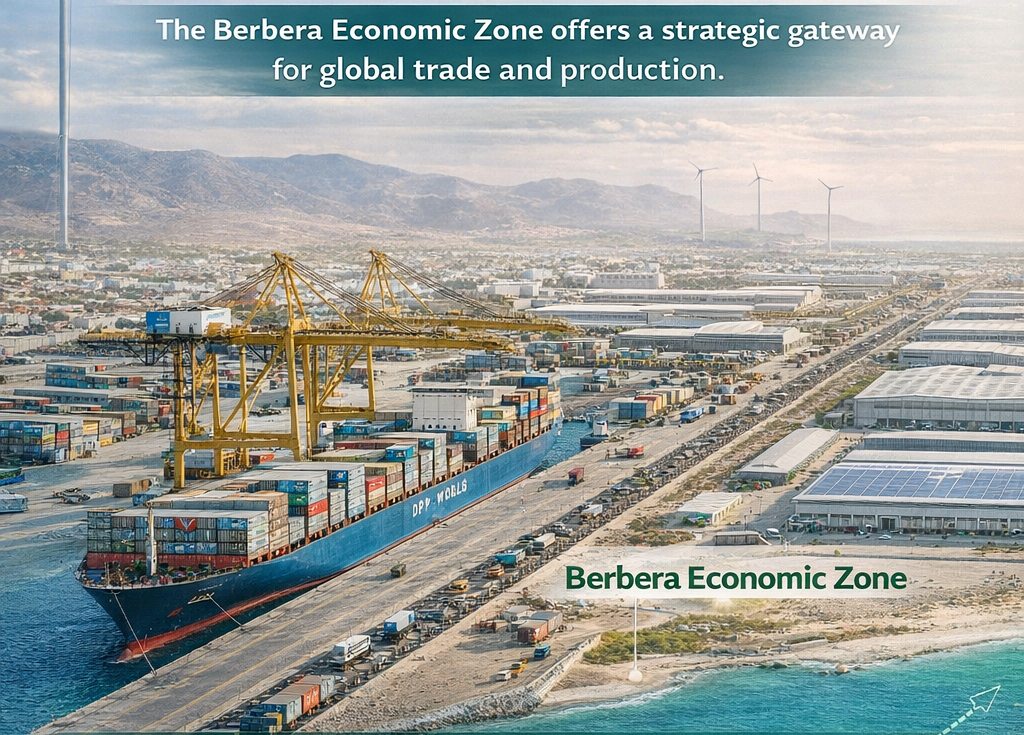
Somaliland is emerging as one of the most promising and under-explored investment destinations in Africa at a time when global companies are actively restructuring their supply chains and searching for new production geographies. In an era defined by geopolitical fragmentation, rising logistics costs, and the need to diversify beyond traditional hubs, transnational corporations are increasingly prioritizing locations that combine political stability, strategic geography, cost efficiency, and access to large integrated markets. Somaliland offers precisely this combination, and at the heart of this opportunity lies the Berbera Economic Zone.
For more than three decades, Somaliland has maintained a proven record of political stability and internal security, making it one of the most stable operating environments in the Horn of Africa. While much of the region has experienced prolonged conflict, Somaliland has built functioning institutions, maintained social cohesion, and established a predictable business environment. This stability is not merely a political achievement; it is an economic asset. For investors, stability translates into lower risk, lower transaction costs, and greater confidence in long-term planning. In global investment terms, Somaliland offers what many frontier markets cannot: continuity.
The Berbera Economic Zone represents Somaliland’s most important strategic economic platform. It is designed as a dedicated industrial and logistics ecosystem that integrates port infrastructure, manufacturing space, trade facilitation, and investment services into a single operational framework. The BEZ is not conceived as a domestic industrial park serving a small local market. It is designed as a regional and continental gateway, enabling transnational companies to assemble, manufacture, process, and re-export goods across Africa, the Middle East, and beyond.
Geography is the first and most fundamental advantage of Berbera. The city sits directly on the Gulf of Aden, adjacent to the Bab el-Mandeb Strait, one of the world’s most critical maritime corridors. A significant share of global trade passes through this narrow channel connecting Asia, the Middle East, Europe, and Africa. This places Berbera in the same strategic class as global ports such as Jebel Ali in Dubai, Salalah in Oman, Djibouti, and Port Said in Egypt. Yet unlike these congested hubs, Berbera offers low traffic density, faster turnaround times, and a substantially lower cost structure. In a global environment where shipping delays and port congestion are increasingly costly, this operational efficiency represents a powerful competitive advantage.
The true multiplier effect of Berbera lies in its direct access to Ethiopia, Africa’s second most populous country and one of its fastest-growing economies. Ethiopia’s market of more than 120 million people generates enormous import demand and remains structurally dependent on external ports for trade. Berbera provides the most direct sovereign maritime corridor to this market. For transnational companies, this creates a rare opportunity to establish manufacturing and distribution operations that can serve Ethiopia efficiently while avoiding the congestion and rising costs associated with existing gateways.
Beyond Ethiopia, the Berbera Economic Zone offers access to two of the largest integrated markets in the world through COMESA and the African Continental Free Trade Area. COMESA alone represents more than 560 million consumers across Eastern and Southern Africa, while AfCFTA connects a continental market of over 1.4 billion people with a combined GDP exceeding three trillion dollars. For multinational companies, this means that production in Berbera is not limited to a small national market. Instead, it provides a platform for continental scale. Goods assembled or processed in the BEZ can be re-export across Africa under preferential trade regimes, positioning Somaliland as a manufacturing and logistics node within Africa’s emerging single market.
This model is not theoretical. It mirrors the pathways followed by the world’s most successful free zones. Shenzhen transformed China into a global manufacturing powerhouse. Jebel Ali turned Dubai into the logistics capital of the Middle East. Tangier Med repositioned Morocco as a European-African industrial bridge. Singapore built its entire development strategy around becoming a trade and production hub despite a small domestic market. In each case, zones acted as catalysts for foreign direct investment, technology transfer, industrialization, and global integration. The Berbera Economic Zone is structurally designed to follow this same trajectory.
Transnational companies already understand the strategic logic of zones. Firms such as Amazon, UPS, FedEx, DHL, Maersk, Microsoft, Google, IBM, Oracle, ExxonMobil, Chevron, Halliburton, Baker Hughes, Coca-Cola, Procter & Gamble, General Electric, Ford, and Tesla all operate extensively through special economic zones across Africa, Asia, and the Middle East. They use these environments to minimize regulatory friction, reduce tax burdens, secure foreign ownership rights, protect intellectual property, and facilitate rapid movement of goods and capital.
Among the first industrial tenants in Berbera is IFFCO, a major UAE-based food company, which has developed an edible oil processing and packaging facility within the Berbera Economic Zone and has already begun exporting to African markets. In addition, several international and regional logistics, trading, and manufacturing companies are already using Berbera Port and the BEZ framework for warehousing, re-export, and corridor-based trade. The World Food Program (WFP) also utilizes Berbera as a key humanitarian logistics hub for regional operations, with more firms currently in advanced stages of registration and onboarding.
The Berbera Economic Zone offers precisely this type of environment, but within a geography that remains largely untapped and competitively priced.
What makes Berbera particularly attractive is not only its location, but its institutional and operational foundations. The presence of DP World as the anchor operator of Berbera Port provides international credibility, operational expertise, and integration into global shipping networks. DP World’s involvement significantly reduces investor uncertainty and aligns Berbera with global best practices in port management and logistics. This is a critical factor, as many African SEZs struggle to attract serious investors due to weak operators, poor connectivity, and limited global integration. Berbera already possesses what most zones aspire to build.
In addition to its strategic location and infrastructure, the Berbera Economic Zone offers a competitive investment framework aligned with global best practices. Companies operating within BEZ benefit from simplified customs procedures, duty-free import of inputs and capital equipment, full foreign ownership, streamlined licensing through a one-stop investment authority under the Somaliland Special Economic Zones Authority, and flexible capital repatriation mechanisms. The zone is designed to provide a predictable regulatory environment, transparent commercial rules, and investor protections consistent with international investment standards, making BEZ a commercially efficient and institutionally reliable platform for long-term operations.
From an operational perspective, the BEZ offers lower congestion, faster clearance times, and reduced logistics costs compared to regional competitors. Labor costs remain highly competitive, land is available at scale, and security conditions are among the strongest in the Horn of Africa. For manufacturing and assembly operations, these conditions translate directly into higher margins and lower operational risk. For logistics and distribution companies, they translate into faster turnaround, greater reliability, and improved service delivery to regional markets.
The industrial potential of the Berbera Economic Zone is broad and highly diversified. Light manufacturing and assembly offer immediate opportunities in electronics, consumer appliances, automotive components, renewable energy equipment, and modular construction materials. Agro-processing presents strong prospects in livestock processing, meat packaging, cold chain logistics, fish export and food manufacturing, building on Somaliland’s existing comparative advantages. Pharmaceutical and medical distribution hubs can serve East African markets through packaging, labeling, and regional warehousing. Digital infrastructure, including data centers and cloud edge facilities, can position Berbera as a technological gateway connecting African markets with Middle Eastern and Asian digital ecosystems.
Israel’s official re-recognition of the Republic of Somaliland on 26 December 2026 has sent a strong market signal, enhancing international confidence and accelerating global engagement, while reinforcing Berbera’s position and the Berbera Economic Zone’s role as a trusted, globally aligned investment platform for transnational companies.
For transnational companies, the economic logic is compelling. The BEZ reduces entry risk into African markets, lowers logistics costs, enables regulatory efficiency, and provides access to large integrated markets. It allows firms to diversify production locations, build resilient supply chains, and establish an early presence in a strategically located growth corridor.
For transnational companies seeking the next frontier of growth, the Berbera Economic Zone offers a proposition that is both rare and timely: a stable political environment, world-class port infrastructure, access to one of Africa’s largest markets, integration into continental trade regimes, and a cost structure that remains globally competitive. Few locations in Africa combine these elements within a single investment platform.
Berbera is not waiting to be discovered. It is positioning itself to become the Horn of Africa’s next major trade and manufacturing hub. For investors and global companies, the question is no longer whether Somaliland will matter economically, but whether they will enter early enough to shape the next chapter of Africa’s industrial geography.